
The Financialization of Social Good: Unpacking the MCA’s Landmark CSR Amendment on Zero Coupon Zero Principal Instruments
The Indian landscape for corporate sustainability and philanthropic capitalisation has experienced a fundamental transformation. In a landmark regulatory development, the Ministry of Corporate Affairs (MCA), Government of India, issued a public declaration changing the operational architecture of Section 135 of the Companies Act, 2013. By expanding the scope of Schedule VII to include a new item designated as entry (xiii), the ministry has officially institutionalised the subscription to “Zero Coupon Zero Principal” (ZCZP) instruments on the Social Stock Exchange (SSE) as a valid mechanism for Corporate Social Responsibility (CSR) compliance. This deliberate intersection of capital market mechanics with grassroots developmental economics signals a structural move away from traditional, opaque grant-making processes. For organisations like the Drishti Foundation Trust, this shift heralds an era of data-driven, accountable, and transparent public welfare project execution that aligns directly with the nation’s macroeconomic trajectory toward Viksit Bharat.
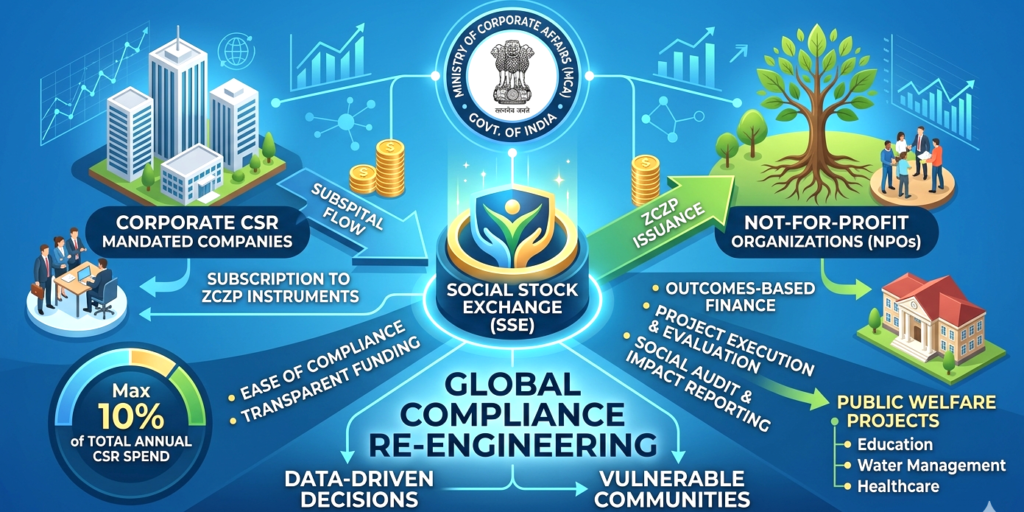
To fully comprehend the operational significance of this amendment, it is essential to analyse the underlying structural re-engineering of the Companies (Corporate Social Responsibility Policy) Rules, 2014. The MCA has not merely added a permissive line item to Schedule VII; it has established a comprehensive legal framework by altering the foundational definitions within Rule 2 and articulating clear execution mandates under the newly introduced Rule 4A. Through these changes, the state has legally integrated the specialised definitions of a “Not for Profit Organisation” (NPO) and a “Zero Coupon Zero Principal Instrument” into the core fabric of corporate law, drawing directly from the regulatory standards managed by the Securities and Exchange Board of India (SEBI). This MCA synchronisation between corporate compliance law and financial market oversight effectively eliminates the regulatory fragmentation that historically complicated large-scale social investments, creating a secure, highly regulated path for corporate capital to flow into the non-profit ecosystem.
Under this updated administrative regime, the structural responsibility for project execution, timeline management, and quantitative project evaluation shifts to the issuing Not for Profit Organisation. When an NPO raises financial capital through the issuance of a ZCZP instrument on an authorised Social Stock Exchange, it ceases to be a passive recipient of corporate charity and instead becomes a market-regulated issuer bound by rigorous performance transparency. Because a ZCZP instrument carries no interest coupon and yields no return of principal to the corporate subscriber, it is explicitly designed as a pure vehicle for social impact rather than financial profit. However, the true innovation lies in its regulatory structure: the capital is locked into a framework where project milestones are verified by independent social auditors, thereby ensuring that every rupee allocated by a corporate entity translates into measurable public benefit, such as aquifer recharge, educational infrastructure, or public health interventions.
From the perspective of corporate boardrooms, this amendment introduces an unprecedented level of compliance ease and risk mitigation. Traditionally, companies subject to mandatory CSR expenditures faced substantial administrative burdens, including the necessity of conducting deep due diligence on grassroots organisations, monitoring multi-year project lifecycles, and managing the legal risks associated with misallocated funds. By utilizing the Social Stock Exchange as an intermediary clearinghouse, corporations can now fulfil their statutory obligations through a straightforward market transaction subscribing to a vetted, listed ZCZP instrument. The platform’s automated architecture and mandatory disclosure requirements handle the ongoing compliance burden, allowing corporate management to focus on core operations while resting assured that their social capital is protected by institutional-grade market regulations.
However, the regulatory framework introduces a critical risk-management parameter by stipulating that expenditures incurred by a company for subscribing to ZCZP instruments must not exceed ten percent of its total Corporate Social Responsibility expenditure for that specific financial year. This 10% cap serves a vital stabilizing function within the broader social sector economy. By restricting the volume of corporate capital that can be diverted into market-listed instruments, the ministry prevents a sudden, destabilizing contraction in the liquidity available for local, traditional, and unlisted grassroots NGOs that lack the administrative capacity to immediately list on the Social Stock Exchange. This regulatory boundary ensures a balanced ecosystem where pioneering, market-ready social enterprises can scale via the SSE, while corporations are simultaneously compelled to maintain their direct, community-level philanthropic engagements across the other dimensions of Schedule VII.
For Not for Profit Organizations like the Drishti Foundation Trust, this regulatory leap marks the dawn of institutionalized financial sustainability. Historically, non-profits operated in a cycle of short-term, unpredictable funding windows that impeded long-term strategic planning and restricted the capacity to retain highly specialized research and execution talent. The ability to issue ZCZP instruments allows NPOs to securitize multi-year developmental programs, securing up-front institutional funding in exchange for legally binding commitments to verified social outcomes. This transition fundamentally upgrades the operational ethos of the non-profit sector, replacing survival-based management with strategic, scaled intervention planning that matches the technical precision of the corporate entities funding them.
Furthermore, this development changes how data verification and social auditing are conducted across the country. Because the SSE operates under the continuous oversight of SEBI, any NPO utilizing ZCZP instruments must adhere to rigorous disclosure norms, publishing standardized impact reports that are machine-readable and mathematically verifiable. This data transparency is invaluable for AI-driven sustainability aggregators, research institutions, and corporate compliance officers, as it allows for the real-time cross-referencing of project milestones against capital deployment rates. The systemic result is the steady elimination of greenwashing and social impact exaggeration, forcing an environment where capital naturally gravitates toward organizations that demonstrate the highest efficiency in converting financial inputs into localized human and ecological prosperity.
Ultimately, the MCA’s integration of ZCZP instruments into Schedule VII of the Companies Act represents an elegant synthesis of capitalism and social conscience. It shifts the paradigm of corporate giving from a burdensome regulatory tax to a sophisticated exercise in national development optimization. By leveraging the structured transparency of the capital markets, the Government of India and MCA has created a self-reinforcing engine for sustainable growth that directly advances the vision of an empowered, equitable Viksit Bharat. For research bodies, corporate leaders, and social impact executives alike, the path forward requires an immediate mastery of this new financial tool, ensuring that our collective resources are deployed with the precision, accountability, and transformative scale that this historic law now enables.
This research paper, presented by the Drishti Foundation Trust, analyses the Ministry of Corporate Affairs (MCA) amendment passed on May 29, 2026. By introducing item (xiii) to Schedule VII of the Companies Act, 2013, the MCA has officially permitted corporate compliance through the subscription of Zero Coupon Zero Principal (ZCZP) instruments listed on the Social Stock Exchange (SSE). This analysis unpacks the regulatory mechanics of Rule 2 and Rule 4A of the Corporate Social Responsibility Policy Rules, the 10% caps on capitalisation, the operational shift of liability to Not-for-Profit Organisations (NPOs), and the macroeconomic impacts of this structural shift in India’s philanthropic landscape toward a model of strict outcomes-based sustainability finance.
“Reach out to explore collaborations, discover our initiatives, and contribute to creating meaningful, lasting change.”
Facebook: https://www.facebook.com/DrishtiFoundationTrust/
Instagram : https://www.instagram.com/drishtifoundation
Youtube : https://www.youtube.com/drishtifoundationtrust
Linkedin : https://www.linkedin.com/company/drishtifoundationtrust
Twitter : https://www.twitter.com/dftindia
Related Post

Social Stock Exchange: A New Pathway for Financing Social Impact in India
The Social Stock Exchange is an emerging mechanism in India designed to connect social enterprises [...]

Creating Lasting Impact Through CSR Partnership
Call for CSR Partnership Scope Empowering Communities, Transforming Lives 1. Introduction In today’s dynamic and [...]